Distributing loop computations in Ripple
Inspired by the simplicity of the OpenMP(R) programming model, we introduced a couple functions in the Ripple API to achieve similar ways of expressing loop parallelism.
The main idea of loop-based parallelism applies to loop computations, in the case when the iterations of a given loop are considered independent from each other. In this case, they can be executed in parallel, by assigning each iteration to a parallel processing element.
The following Figure represents values of an “i” loop (in blue)
being distributed onto blocks of size 8 (in orange),
in a function that performs an element-wise addition.
We illustrate the distribution for n = 19. VECTOR_PE is zero.
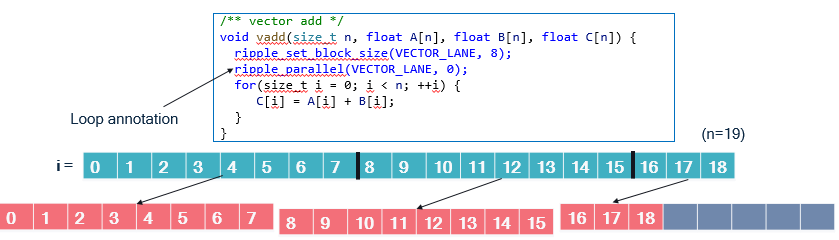
In the vadd function, we can see two calls to the ripple API:
ripple_set_block_shape(VECTOR_LANE, 8)models the set of parallel processing elements to run the function as a block of size 8. TheVECTOR_LANEparameter represents that the kind of targeted processing elements (the lanes of a fictitious vector engine here). This notion of block is the same as the one used in the SPMD programming model supported by Ripple. In fact, loop annotations are syntactic sugar that make SPMD programs more readable.ripple_parallel(BS, 0)indicates that the immediate next statement is a loop whose iterations should be distributed to the blockBS. The mapping between values ofiand block index is cyclical, i.e., computations made for loop indexiare mapped to block indexi % 8. The 8 in the mapping is the block size (along the one and only dimension of the block, 0).
Benefits compared with SPMD programming
The main advantage of loop annotations is that we can just find a
loop whose iterations are independent and which accesses data contiguously,
and declare this a parallel loop.
When the number of iterations in the parallel loop does not exactly
match the block size, ripple_parallel takes care of
separating the loop into a full-vector loop and an epilogue.
In the SPMD model, we need to perform that separation explicitly.
The vadd example provides a good means of comparison with SPMD.
The code below is the equivalent function in SPMD.
void vadd(size_t n, float A[n], float B[n], float C[n]) {
  size_t i;
  ripple_block_t BS = ripple_set_block_shape(VECTOR_PE, 8);
  size_t nv = ripple_get_block_size(BS, 0);
  size_t v = ripple_id(BS, 0);
  for (i = 0; i + nv <= n; i += nv) { // Full vector loop
    C[i + v] = A[i + v] + B[i + v];
  }
  // Masked, partial vector epilogue
  if (i + v < n) {
    C[i + v] = A[i + v] + B[i + v];
  }
}
Since n is unknown, we have to take into account the case when
n is not a perfect multiple of the block size, 8.
When it is not, the last vector will have to load and store
only the values that are within the array bounds, i.e., less than n.
To do so efficiently, we first compute a loop for the cases when we know
that the full vector needs to be loaded, computed and stored.
Let’s call it the full-vector loop.
Then, the last, partial vector needs to be computed in a so-called epilogue.
That last computation is controlled by the conditional i + v < n
to avoid out-of-bounds accesses.
The comparison between implementations is straightforward:
- The
ripple_parallel()-based implementation is about half as long. - It is also just as readable as the sequential implementation, only with two extra lines of code. The SPMD version is less readable.
- the
ripple_parallel()version takes care of full-vector and epilogue separation behind the scenes.
Full-vector cases
It may happen that the loop we want to distribute actually fits perfectly
onto the targeted block size.
In this case, computing an epilogue seems wasteful.
Use the ripple_parallel_full() function,
which doesn’t generate the epilogue.
Pragma form
In C and C++, calls to ripple_parallel are implemented
under the hood as a pragma decorating the following loop.
Here’s the syntax for it:
#pragma ripple parallel Block(block_shape) Dims(<dim ...>) [NoRemainder]
block_shape_variable, aripple_block_tvalue, i.e., the output ofripple_set_block_shape()stored in a variable. You cannot pass the call toripple_set_block_shape()directly to aBlock()construct. TheNoRemainderclause turns on the full-vector assumption, in which the epilogue isn’t generated.
Block index access
The ripple_parallel annotation basically chunks the annotated loop
by the size of the block dimensions associated with it.
The resulting loop basically iterates over blocks,
and the original loop variable (let’s call it i)
can be retrieved from the block loop iterator (let’s call it b)
and the ripple index associated with the loop (let’s call it v).
Let’s assume that we have distributed our i loop along block dimension 1.
i, b and v are related through:
i = ripple_get_block_size(block_shape, 1) * b + ripple_id(block_shape, 1)
The ripple_parallel_idx() API provides access to the block loop operator (b).
Hence if we distribute loop i along dimension d,
we have the identity:
i = ripple_get_block_size(block_shape, d) * ripple_parallel_idx(block_shape, d) + ripple_id(block_shape, d)
When ripple_parallel is used to distribute loop iterations over
more than one block dimension, the use of ripple_parallel_idx is expected
to be consistent with these dimensions.
Using ripple_parallel_idx outside of ripple_parallel-annotated loops
results in an error.
Syntactic constraints
The syntax for loops that follow a
ripple_parallel() call must follow a rigid syntax.
An error is returned upon violation of these syntax rules.
- The initialization (lower bound) cannot be an expression; it must be a constant or a variable name.
- The exit test (upper bound) must compare the loop counter using
<with a constant or a variable name. - The loop counter step must be one (as in
++iori++).
For instance, the following code is unsupported because its upper bound is syntactically too complex.
#define VECTOR_PE 0
void vecadd_subarray(int N, int start, int end,
                     float x[N], float y[N], float xpy[N]) {
  ripple_block_t BS = ripple_set_block_shape(VECTOR_PE, 32);
  ripple_parallel(BS, 0);
  for (int i = start; i < min(end, 129); ++i) {
    xpy[i] = x[i] + y[i];
  }
}
Fortunately, there is an easy workaround.
We can precompute the min expression into a variable,
and use that variable as the upper bound, as follows.
void vecadd_subarray(int N, int start, int end,
                    float x[N], float y[N], float xpy[N]) {
  ripple_block_t BS = ripple_set_block_shape(VECTOR_PE, 32);
  size_t my_min = min(end, 129);
  ripple_parallel(BS, 0);
  for (int i = start; i < my_min; ++i) {
    xpy[i] = x[i] + y[i];
  }
}
While these syntactic constraints theoretically make the loop annotation parallel programming model less generally expressive than the SPMD model, we expect that it will still allow parallelization of a large portion of code, if not all of it.
General principles
At a high level, the difference between this loop annotation model and the SPMD model is that the annotation model introduces an automated way to distribute loop iterations. The loop annotation model is implemented as syntactic sugar on top of the SPMD model. Hence, all aspects of the SPMD model are maintained in the loop annotation model, in particular:
- Computations are represented as blocks.
- Multi-dimensional blocks are supported. To achieve this, multiple loops may be distributed onto a block.
- We can access a block element using
ripple_id(). This is similar to usingomp_get_thread_num()in OpenMP(R) loops. - The shape of a computation is still determined by implicit broadcasting and special shape-modifying functions.
- How conditionals affect parallel code.
- Implicit scalar expansion.
Each of these concepts is presented in the chapter describing SPMD programming with Ripple.
OpenMP is a registered trademark of the OpenMP Architecture Review Board.
Copyright (c) 2024-2025 Qualcomm Innovation Center, Inc. All rights reserved. SPDX-License-Identifier: BSD-3-Clause-Clear